
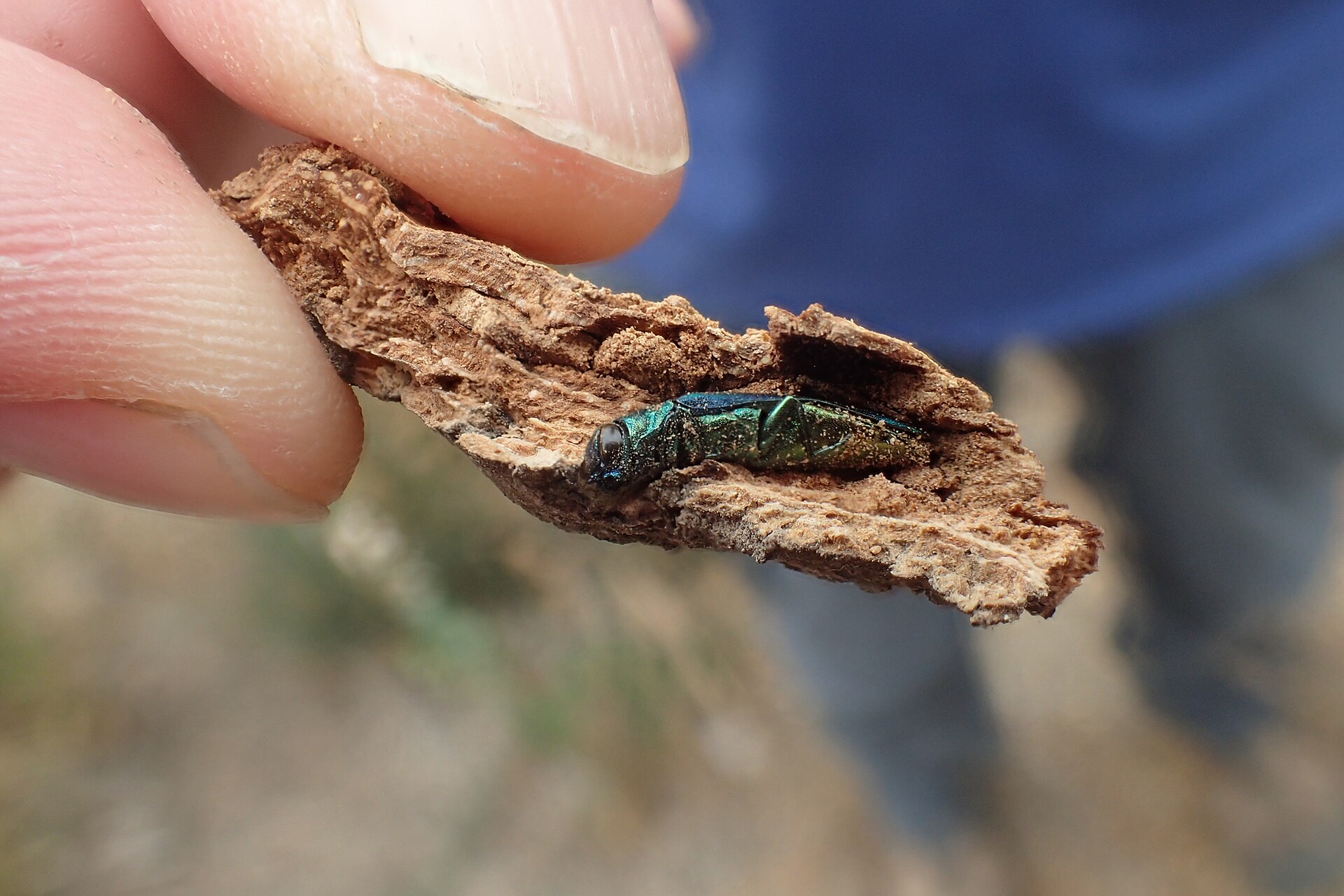
We were at New York State Woodsmen’s Field Days this past August, and we had a great time meeting all of you folks, showing off some machines, and hearing about what’s going on elsewhere in the forestry world. There was one thing that we heard a lot about. People are either worried about it or actively managing it, and it’s something that we know a thing or two about; Agrilus planipennis, the emerald ash borer beetle.
Split-Fire is located in Ontario Canada, where we’ve been fighting a hard battle with the emerald ash borer since the early 2000s. Today, while ash mortality varies between different woodlots in different parts of the province, over 90% percent of native Ash trees in the southernmost areas of Ontario have been wiped out by the beetle. Because we’ve seen what it can do firsthand, we want to talk about what Ontario learned from our trial-and-error approach with the emerald ash borer, and how New York might be able to escape a similar fate.
The emerald ash borer was first detected in both Detroit, Michigan and Windsor, Ontario in 2002, likely coming in through untreated wood packaging materials on cargo ships. The beetle’s spread deeper into Southwestern Ontario was fast, and by late 2003 the Canadian Food Inspection Agency had already realized that it posed a serious threat to Canada’s timber sector. To stop it from moving any further, the CFIA established an ash-free zone, consisting of a 10-kilometer wide (roughly 6-mile) buffer area along the border of the infested regions, in which roughly 80,000 to 150,000 ash trees both healthy and infected were clear-cut, and the movement of all ash forest products was prohibited. The strategy, while intense, was ineffective; only a year later, by late 2004, active infestations were found miles east of the ash-free zone. Not only has research shown that adult beetles can fly up to 10 kilometers on their own on rare occasions, but they and their larvae can also easily hide in a bundle of firewood and travel a virtually unlimited distance that way, so it didn’t take too many people disobeying the transportation prohibition for the beetles to spread all over the province.
The emerald ash borer was first identified in New York State in 2009, and since then has spread to all but two counties. Having seen the battle play out in Ontario and the US Midwest already, New York forestry officials had a head start and have been implementing strategies based on what they learned.
In contrast to the CFIA’s early clear-cut strategy, New York officials have been performing more targeted removal of infected trees. Researchers at institutions like Cornell University have also been studying “lingering ash” – rarely occurring trees with an immunity to the beetle, that remain healthy when 95% of surrounding trees have died. The hope is that these trees can be cultivated to create fully immune ash forests in the future.
While the emerald ash borer has no natural predators in North America, it’s kept in check in its native Asia by four species of wasp. Officials in the United States have been carefully introducing these wasps into infested areas, with studies showing that this can decrease the population density of the beetles by up to 76%, potentially allowing ash tree populations to recover. Starting in 2013, a US lab began providing wasp specimens to the Canadian Forest Service, allowing for their release in Canada as well.
Meanwhile, Canadian Forest Service scientists were developing a natural insecticide based on extracts from the neem tree. This insecticide, called TreeAzin, can be injected directly into infected trees that have not been extensively damaged, and was approved nationally for use in Canada in 2012. TreeAzin, along with other tree injections, is now widely used across New York State as well.
Our experience with the emerald ash borer in Ontario proved that we can’t just cut our way out of an infestation, dealing with it will take both active management and public education.
The single biggest takeaway from the two decades of fighting the beetle in Ontario and New York is that the spread of the emerald ash borer is driven mostly by human movement. If you use firewood, BURN IT WHERE YOU BUY IT. Moving ash logs, even ones that might look healthy at a glance, can be the difference between preserving an uninfected woodlot, and spreading the pest even further.
https://inspection.canada.ca/en/plant-health/invasive-pests-and-plants/insects/emerald-ash-borer
https://inspection.canada.ca/en/plant-health/invasive-species/insects/emerald-ash-borer/wasps
https://osdp-psdo.canada.ca/dp/en/search/metadata/NRCAN-CFS-1-34930
https://www.canada.ca/en/news/archive/2004/06/ash-free-zone-regulations.html
https://cornellbotanicgardens.org/conserve/invasive-species/emerald-ash-borer